
India's net oil import bill could widen to $101-104 billion in current fiscal from $96.1 billion in 2023-24 and any escalation in the Iran-Israel conflict could impart an upward pressure on the value of imports, ICRA said on Tuesday. The domestic rating agency said based on its analysis, lower value of Russian oil imports is estimated to have led to savings of $7.9 billion in 11 months (April-February) of 2023-24, up from $5.1 billion in 2022-23.

Delhi high court on Friday rejected a plea against exemptions granted to women and two-wheelers in the odd-even car scheme, scheduled to resume from April 15, terming it "premature".
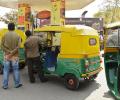
Amid a shift in mobility trends and people increasingly opting for less polluting energy sources, sales of compressed natural gas (CNG) vehicles increased more than 82 per cent in the past five years. A total of 729,902 CNG vehicles were sold in 2022-23 against 400,825 in 2017-18, according to VAHAN Dashboard. Though the increase in sales of CNG-powered vehicles has been significant, their share in overall vehicle sales remains minuscule as is the case with EVs.

British energy firm BG Group on Thursday said it along with its partners state-owned Oil and Natural Gas Corp and Reliance Industries Ltd will invest $140 million in Panna oil and gas fields

Link between oil exploration and markets can be used by India to great advantage.
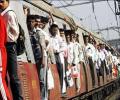
The minister wants maximum use of alternative fuel in rail operations.

Lower fuel subsidy payouts might restrict gross fiscal deficit in FY15.
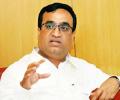
Former Union minister Ajay Maken, considered close to Congress vice-president Rahul Gandhi, will be the party's face in the coming Delhi assembly polls.
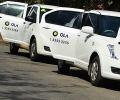
Predatory pricing petitions against Ola, Uber were filed from across cities.

Maruti is sticking to this strategy at a time when rival Hyundai is looking to make the most of the monopoly it will have in the compact diesel segment from April 1, 2020, when the BSVI emission norms kick in. The market leader's confidence stems from the rapid shift in favour of petrol in the PV segment. For newer models such as MG Hector and Seltos, nearly 75 per cent bookings are for petrol variants, Kia has 55 per cent from petrol variants. The change in customer preference from diesel variants to petrol has happened quickly over the past few years.


The conversion produces significantly more energy than it requires and results in transportation fuels -- diesel, for example -- that can be blended with existing ultra-low-sulphur diesels and bio-diesels, researchers said.
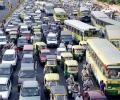
It pulled up the Delhi government for its plan to introduce 6,000 new buses without conducting any study or research.
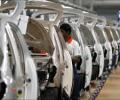
Tampering with electrical fittings of a car, subjecting it to improper maintenance or making unwarranted changes to it are the primary reasons behind the spurt in cases of vehicle fires, which have claimed several lives in the recent past.

India is, indeed, particularly vulnerable to this menace.

Volkswagen was not the largest carmaker in the US and that North America accounted for merely 1-1.5 per cent of its total sales.

India's electric mobility goal, which has so far been riding on two wheels, is all set to graduate to four wheels. At least, the journey has begun. Hyundai Motor India said it would invest Rs 4,000 crore till 2028 to launch half-a-dozen electric vehicles (EVs) in India. It would eventually straddle premium and mass segments. The first of these - the electrified version of an internal combustion engine (ICE)-powered model - will go on sale as early as next year.

India has a history of jugaad, and retrofitting vehicles is one such manifestation of the legendary Indian skill. Not so long ago autorickshaws and small Marutis used to strap on subsidised LPG cylinders and power themselves to a cheap ride. There were the odd explosions, lives were lost, but the jugaad continued. Then compressed natural gas (CNG) was introduced in Delhi following a court order. Initially, customised CNG kits were fitted to conventional (internal combustion engine or ICE) autos cheaply, enabling commuting at less than half of what you would cough up for diesel. The industry is better organised now with Suzuki and Hyundai designing CNG-fired vehicles, and Mahindra and TVS manufacturing liquefied petroleum gas (LPG)-powered three wheelers.

If you live in Delhi you can quit smoking, give up alcohol, go to bed early, exercise every day and eat right, but unless you also give up breathing, you can still get very sick, says Mitali Saran

According to research by IHS Markit, for an ecosystem still grappling with infrastructure issues -- the high cost of EVs and a greater OEM (original equipment manufacturer) focus on electrifying two-wheelers and commercial vehicles first -- the share of such vehicles is expected to be 4 per cent by 2030, reports Pavan Lall.

The diesel car becomes too expensive with BS-VI and market assessment says the customer will not buy it at that price, says R C Bhargava, chairman, MSIL. He expects buyer preference to change swiftly in favour of petrol, CNG, and other alternative technologies.

As part of efforts to curb pollution, the Centre is in the final stage of completing the Rs 10 crore pilot project under which 10 refurbished electric buses will be handed over to select State Transport Corporations by March 2016.
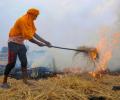
To prevent rise in air pollution levels, oil marketing companies and thermal power units were planning to procure stubble from farmers to make bioethanol and promote the central government's 'Agricultural Mechanization' for crop residue management. But both have seen minimal success.

Experts prefer domestic consumption-driven plays and defensives such as information technology and pharmaceuticals

New Delhi's overall air quality index read 456 at 4 pm, up from 425 at 4 pm on Tuesday.

With many exemptions and caveats, the road-rationing system may be another disappointment in reducing Delhi's pollution woes.
Cars with engine capacity of 2000 cc and above will not be registered in Delhi and National Capital Region till March 31, 2016

The Centre has accorded top priority for cost-effective, pollution-free transportation modes, such as waterways, which reduce logistic costs and increase road safety. Union minister of roads, highways, ports and shipping Nitin Gadkari speaks to Sanjay Jog about the government's strategy.

Every time we pointed out the overwhelming evidence of diesel's toxicity, we were brushed aside.

Air that people breathe in Indian cities is among the worst in the world.

Congress leader Anand Sharma said the scheme was coming in the way of MPs discharging their duties and not being able to attend the meetings of Parliamentary Committees due to it.
Govt may delay BS-V and -VI implementation by a year
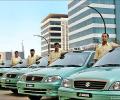
The amendment comes within a month of web-based taxi companies being banned in Delhi, after a taxi driver on Uber's network allegedly raped a finance executive early this month.

'The answer is no, the entire country's is.' 'So why such obsession with Delhi?' 'But the most powerful people in India live here: The prime minister, civil servants, Supreme Court judges, MPs, diplomats, dadas of the media...' 'If they can't deal with their own problem, what chance does the rest of the country have, with its foul air, dying rivers, frothing lakes, and crumbling mountains?' says Shekhar Gupta.
If IOC is not allowed to run its own affairs, then we can see it close down in the next 10 to 15 years, warns Sudhir Bisht.

'That is the one headline the world is reading about India this week, and it is a potentially damaging story...' 'I don't think a panic mentality has set in, but this story is one that investors and market watchers are absolutely seized with.'

Delhi's air is a desperate problem, but some of the solutions have been too desperate and unthinking.

Prime Minister Narendra Modi on Monday gave a clarion call for a "global people's movement" to bring about a behavioral change to deal with climate change as he made a path-breaking pledge to more than double India's non-fossil fuel target to 400 gigawatts.

'People residing in the enclaves have led completely isolated lives. They are stateless, have no official identity proof.' 'It is significant that Modi, Banerjee, Sarkar and Gogoi, despite having different political ideologies, are walking in tandem for the cause of the people residing in the enclaves.' 'If the LBA betters the economy of India and Bangladesh, there will be less turmoil in both these countries.'
